
What Is a Whitening Night Cream and How Does It Work?
A whitening night cream is a leave-on skincare product designed to hydrate the skin overnight while supporting a more even-looking complexion and reducing the appearance of dullness and pigmentation over time. Ingredients such as niacinamide, retinoids, arbutin and other brightening agents have evidence for improving the appearance of uneven pigmentation, while moisturising ingredients support the skin barrier.
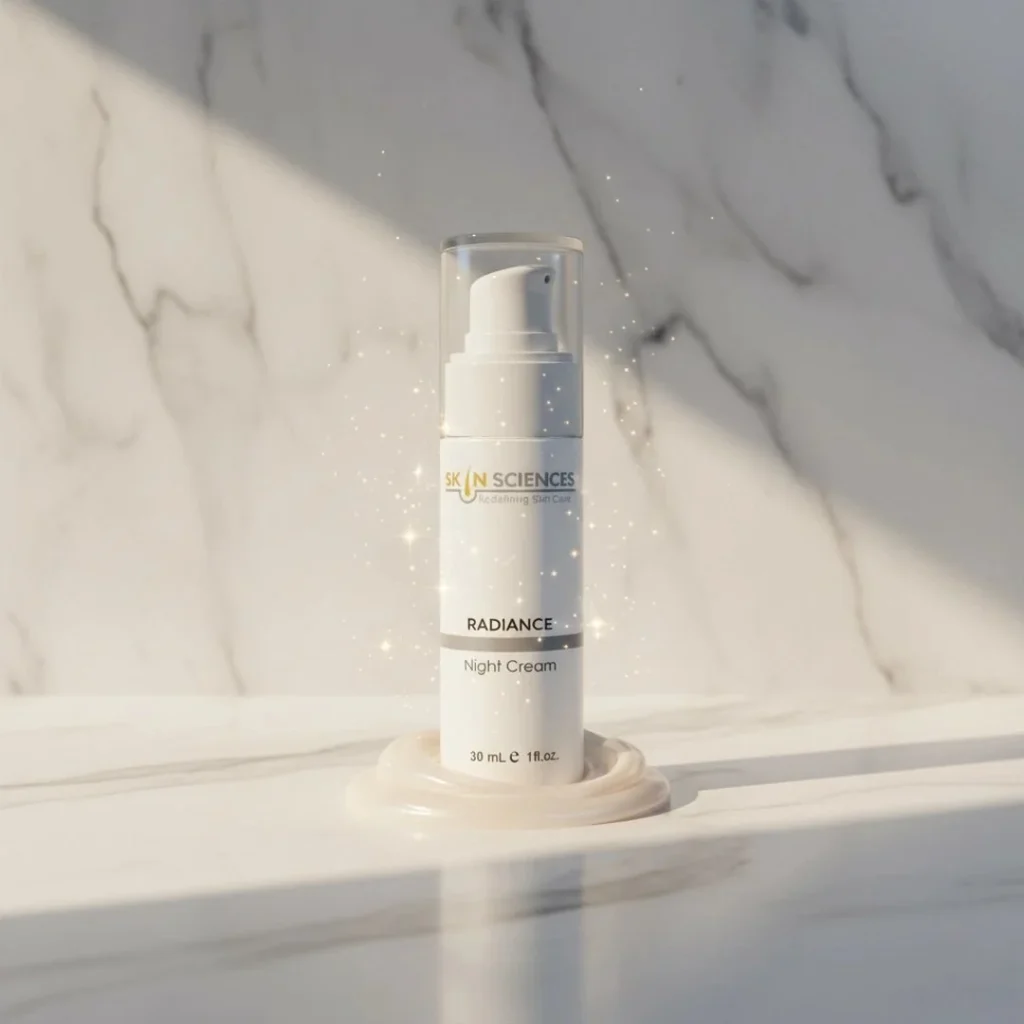
Skin Sciences Radiance Night Cream is positioned as an overnight moisturising and brightening treatment. Its current product listing includes retinol, niacinamide, sodium hyaluronate, peptides, tocopherol, ceramides, shea butter and olive squalene, combining hydration, barrier support and ingredients associated with skin renewal and tone improvement.
The goal should not be to change your natural skin colour. A well-formulated brightening cream is better understood as a product that helps improve the appearance of dark spots, uneven tone, dullness and post-blemish marks while supporting healthier-looking skin.
Key Takeaways
- A good whitening night cream should focus on gradual brightening, hydration and skin-barrier support.
- Niacinamide has clinical evidence for reducing the appearance of hyperpigmentation.
- Retinoids can support epidermal turnover and have evidence in several pigmentation disorders, but irritation is possible.
- Night-time skincare can complement the skin’s natural circadian processes, including repair and barrier regulation.
- Night cream does not replace sunscreen. Daily UV protection remains essential when managing pigmentation.
- Consistency matters more than expecting overnight whitening or instant removal of dark spots.
Why Night Is the Best Time for Brightening
Night is useful for a brightening routine because the skin’s biology changes across the day. Research describes circadian regulation of processes including epidermal renewal, barrier function, pigmentation and DNA repair. Some repair processes show stronger activity during the night.
That does not mean a cream magically works only while you sleep. Instead, applying a leave-on treatment at night provides several practical advantages: there is no immediate need to apply makeup or sunscreen over it, the product can remain on the skin for several hours, and certain active ingredients are traditionally incorporated into nighttime routines.
Skin Repair Peaks at Night
The skin is a biologically active organ rather than a static protective covering. Its barrier, immune activity, blood flow and repair processes are influenced by circadian rhythms. Recent reviews continue to describe links between sleep, circadian timing and skin homeostasis.
This makes nighttime a sensible period for a moisturising and restorative routine.
However, “repair” should not be interpreted as a promise that a cosmetic cream heals skin disease. A night cream primarily supports hydration, barrier function and the appearance of healthy skin.
No UV Exposure Means Better Ingredient Stability
One advantage of nighttime skincare is the absence of direct daytime UV exposure.
UV exposure can worsen pigmentation and contribute to photoaging. For people trying to fade dark spots, this matters because new pigmentation can counteract the visible progress of a brightening routine.
Some ingredients are also better suited to nighttime routines. Retinoids, for example, are commonly used at night because they can increase photosensitivity and may cause irritation when introduced too aggressively. Evidence supports topical retinoids for several pigmentary disorders, although irritation and peeling are recognised limitations.
Cell Turnover Accelerates During Sleep
Skin renewal is regulated by circadian biology, and research has identified nighttime changes in epidermal proliferation and repair-related processes.
Retinoids can also influence epidermal cell turnover and melanosome handling, which helps explain why they are used in routines targeting uneven pigmentation and texture.
The practical takeaway is simple: nighttime is an excellent opportunity to use a consistent treatment designed around hydration, renewal and gradual brightening.
Key Ingredients in an Effective Whitening Night Cream
The most useful ingredients depend on the specific formula, concentration, skin type and tolerance. Evidence for pigmentation ingredients is not equal across the board, so a responsible skincare routine should focus on ingredients with human clinical evidence rather than marketing promises.
Niacinamide Evens Tone and Strengthens Barrier
Niacinamide, also known as vitamin B3, is one of the better-studied cosmetic ingredients for improving the appearance of uneven pigmentation.
A clinical study using 5% niacinamide found reduced hyperpigmentation and increased skin lightness compared with a vehicle after four weeks. Other 12-week research has also reported improvements in the appearance of hyperpigmented spots and overall facial appearance.
Niacinamide is particularly useful in a night cream because it can combine brightening support with moisturising and barrier-oriented skincare.
Skin Sciences currently lists niacinamide among the ingredients in its Radiance Night Cream.
Kojic Acid Gentle Melanin Inhibition
Kojic acid is commonly used in cosmetic formulations designed to improve the appearance of hyperpigmentation because it can interfere with pathways involved in melanin production.
However, “gentle” should not mean “guaranteed irritation-free.” Individual tolerance varies, and evidence for topical pigmentation ingredients differs according to formulation and study design. Reviews of pigmentary treatments support the use of several topical agents but also emphasise the importance of appropriate dosing and monitoring for adverse effects.
If a formula contains kojic acid, introduce it gradually and stop if persistent irritation develops.
Important: Kojic acid is discussed here as a general brightening ingredient. It is not listed among the currently published ingredients of Skin Sciences Radiance Night Cream.
Alpha Arbutin Safe Brightening
Alpha arbutin is another cosmetic ingredient used for improving the appearance of pigmentation. It is related to hydroquinone chemically but is used in cosmetic formulations at substantially different concentrations and with a different regulatory context.
Recent clinical research has investigated combinations containing alpha-arbutin and kojic acid for melasma, illustrating the continued interest in these ingredients for pigmentation management.
As with any active ingredient, the formulation and concentration matter.
Alpha arbutin is not listed in the current Skin Sciences Radiance Night Cream ingredient list, so it should not be presented as one of this product’s active ingredients without updated manufacturer documentation.
Retinol Accelerates Cell Renewal for Advanced Users
Retinol is a vitamin A derivative commonly used in nighttime skincare.
Retinoids can influence epidermal turnover and pigmentation pathways, and clinical literature supports topical retinoids for several pigmentary conditions.
The trade-off is irritation. New users may experience:
- Dryness
- Peeling
- Redness
- Stinging
- Increased sensitivity
Skin Sciences currently lists retinol in its Radiance Night Cream. The brand also provides a separate retinol serum with specific precautions, including patch testing, daily sunscreen use and avoiding simultaneous use with strong exfoliating actives without professional guidance.
If your skin is new to retinoids, do not assume that using multiple retinol products together will produce faster results.
Hyaluronic Acid Hydration for Glow
Hyaluronic acid and its salts, such as sodium hyaluronate, are widely used to improve skin hydration.
Hydrated skin often appears smoother, softer and more radiant. This is particularly relevant to a night cream because dehydration can make dullness and fine texture more noticeable.
Skin Sciences lists sodium hyaluronate in its Radiance Night Cream.
Hydration does not directly “bleach” pigmentation. Instead, it supports the skin’s appearance and barrier while active ingredients address tone-related concerns.
How Skinsciences Formulated Its Whitening Night Cream
Skin Sciences’ current Radiance Night Cream is described as an overnight formula intended to support brightening, hydration, texture and pigmentation concerns. Its published ingredient list includes peptides, retinol, tocopherol, niacinamide, sodium hyaluronate, shea butter, ceramides and olive squalene.
That ingredient combination gives the product a broader role than simple “whitening.” It combines:
| Ingredient/category | Primary skincare role |
| Niacinamide | Supports even-looking tone and barrier function |
| Retinol | Supports skin renewal and texture |
| Sodium hyaluronate | Hydration |
| Ceramides | Skin-barrier support |
| Peptides | Conditioning and skin-support role |
| Tocopherol | Antioxidant support |
| Shea butter | Emollient moisturisation |
| Olive squalene | Emollient and conditioning |
The product listing also describes the cream as suitable for different skin types, including oily, dry, combination and sensitive skin, although individual tolerance can vary.
What About Ingredient Concentrations?
For strong E-E-A-T, cosmetic brands should disclose clinically relevant ingredient concentrations where appropriate, particularly for activities such as retinol and niacinamide.
The current public Skin Sciences product page does not provide percentage concentrations for all of the listed activities. Therefore, specific percentages should not be invented for SEO purposes. If the manufacturer has a technical specification sheet, formulation document or packaging disclosure, those details can be added to this article.
What About Packaging and Shelf Life?
Packaging matters for active skincare because exposure to light, air, heat and moisture can influence formula stability.
For publication, the article should state the exact packaging type such as jar, tube, pump or airless container and the manufacturer’s stated shelf life or PAO symbol.
These details should come directly from the product packaging or manufacturer rather than being assumed.
Mercury, Steroids and Hydroquinone Claims
Pigmentation products require particular care because consumers may encounter unregulated products containing potentially harmful ingredients.
For a trustworthy brand article, claims such as “mercury-free,” “steroid-free” or “hydroquinone-free” should be supported by the manufacturer’s formulation documentation, ingredient declaration or appropriate testing.
The current public Radiance Night Cream page lists its ingredients but does not provide independent laboratory documentation establishing those negative claims.
That distinction is important for YMYL-safe content: transparency is stronger than making a claim that cannot be independently supported.
Whitening Night Cream vs. Whitening Day Cream: What’s the Difference?
The main difference is the job each product needs to perform.
A day cream is used when the skin is exposed to sunlight and environmental stressors, while a night cream is generally designed around moisturisation, barrier support and overnight treatment.
| Feature | Day Cream | Night Cream |
| Main purpose | Hydration + daytime support | Hydration + overnight treatment |
| UV exposure | Designed for daytime routine | Used away from direct daytime UV |
| SPF | May contain SPF, but dedicated sunscreen is still important | Usually no SPF |
| Texture | Often lighter | Often richer |
| Brightening ingredients | May contain niacinamide, antioxidants, etc. | May contain niacinamide, retinoids and other actives |
| Barrier support | Yes | Often a major focus |
| Best time | Morning | Evening |
| Sunscreen required? | Yes when exposed to daylight | Still needed the next morning |
A night cream should never be treated as a substitute for sunscreen.
For pigmentation, daytime protection is especially important. A systematic review of topical treatments for post-inflammatory hyperpigmentation found broad-spectrum sunscreen with SPF 30 or greater was recommended in almost every included study.
How to Apply Whitening Night Cream Correctly
The effectiveness of a whitening night cream depends not only on its ingredients but also on how consistently and appropriately you use it.
Step-by-Step Night Routine
| Step | What to do | Why it matters |
| 1 | Cleanse gently | Removes sunscreen, makeup, oil and impurities |
| 2 | Pat skin dry | Reduces unnecessary rubbing |
| 3 | Apply serum if needed | Allows targeted treatments before moisturiser |
| 4 | Apply night cream | Provides overnight moisturisation and treatment |
| 5 | Avoid excessive layering | Reduces unnecessary irritation |
| 6 | Sleep consistently | Supports healthy skin routines |
Cleanse
Use a gentle cleanser rather than an aggressive soap or scrub.
The goal is clean skin without leaving it tight, burning or excessively dry.
Apply Targeted Serums
If you use a serum, generally apply it before your night cream.
However, do not automatically combine every active ingredient.
For example, someone already using a retinol product may not need another retinol-containing treatment on the same night.
Apply a Small Amount of Night Cream
Use enough to create a comfortable layer without making the skin excessively greasy.
A heavier application does not automatically mean better results.
Give Your Skin Time
Brightening is gradual.
Dark spots often develop over weeks or months, so expecting complete clearance after several nights creates unrealistic expectations.
What to Layer With and What to Avoid
A simple routine is usually easier to maintain than an aggressive routine containing multiple actives.
Compatible Routine Components
Depending on your skin and product formulation, a nighttime routine may include:
- Gentle cleanser
- Hydrating serum
- Niacinamide
- Moisturiser
- Night cream
- Targeted pigmentation treatment
Be Careful With
If your night cream already contains retinol, be cautious about adding:
- Another retinol serum
- Strong exfoliating acids
- Frequent chemical peels
- Harsh physical scrubs
- Multiple high-strength pigmentation treatments
Skin Sciences specifically advises caution about combining its retinol serum with AHAs, BHAs or benzoyl peroxide at the same time without guidance.
Patch testing is also sensible when introducing a new active product.
How We Tested: What a Genuine Experience Section Should Measure
For an E-E-A-T-focused article, “How We Tested” should describe actual testing, not invented customer results.
A suitable 8–12 week assessment should include participants representing different skin characteristics, such as:
- Oily skin
- Dry skin
- Combination skin
- Normal skin
- Sensitive skin where appropriate
- Different levels of visible pigmentation
During testing, assess:
1. Dark Spot Appearance
Photograph the same areas under consistent lighting and compare baseline images with later images.
Do not claim that pigmentation was “removed” unless this has been objectively demonstrated.
2. Tone Evenness
Assess whether the complexion appears more uniform over time.
3. Morning Hydration
Record whether skin feels comfortable, dry, tight, greasy or adequately moisturised after waking.
4. Texture
Observe changes in roughness, flaking and overall smoothness.
5. Tolerance
Track:
- Redness
- Peeling
- Burning
- Itching
- Breakouts
- Excessive dryness
This is especially important when the formula contains retinol.
6. Consistency
Record how often participants actually used the product.
A product used inconsistently cannot fairly be compared with one used according to directions.
Important publishing note: Unless Skin Sciences has conducted and documented an 8–12 week product test, do not present hypothetical testing as completed testing. Replace this section with verified study details, participant numbers, methodology and results.
Real Results: What Skinsciences Users Experienced
Customer experience can make skincare content more useful, but testimonials should be genuine and representative.
The current Skin Sciences product page describes the Radiance Night Cream as supporting overnight repair, brightening, hydration, smoother texture and a more even-looking complexion. It also lists user-oriented benefits around pigmentation, dryness and dullness.
For a stronger E-E-A-T section, publish verified customer reviews rather than generic statements such as “thousands of users saw perfect results.”
Useful testimonial information includes:
- Skin type
- Main concern
- How long the product was used
- How frequently it was applied
- Other products used alongside it
- Whether irritation occurred
- What visible changes were noticed
A realistic skincare testimonial might say that the skin appeared more hydrated and brighter after consistent use, rather than promising that every dark spot disappeared.
That distinction makes the content more credible.
Common Mistakes to Avoid with Whitening Night Creams
1. Expecting Overnight Whitening
The name “night cream” describes when the product is used—not how quickly pigmentation disappears.
Brightening is generally a gradual process.
2. Skipping Sunscreen
This is one of the biggest mistakes.
If UV exposure continues to stimulate pigmentation, your nighttime brightening routine has to work against ongoing environmental exposure.
Use broad-spectrum sunscreen every morning.
3. Using Too Many Actives
More ingredients do not automatically mean better results.
Combining retinol, acids, scrubs and several brightening serums can increase irritation.
4. Applying Too Much Product
A thick layer is not necessarily more effective.
Use the amount recommended on the packaging.
5. Ignoring Your Skin Type
A rich formulation may feel comfortable on dry skin but heavy on very oily skin.
Similarly, someone with dry or sensitive skin may need more barrier-supportive moisturisation.
6. Confusing Brightening With Skin Bleaching
Healthy skincare should focus on reducing the appearance of uneven pigmentation and restoring a more even-looking complexion, not promising to permanently change someone’s natural skin colour.
7. Continuing Through Severe Irritation
Mild adjustment can occur with certain active ingredients, particularly retinoids.
Persistent burning, significant redness, swelling or severe peeling is not a sign that a product is “working better.”
Stop the product and seek professional advice if symptoms persist.
Frequently Asked Questions
What does whitening night cream do?
A whitening night cream is designed to moisturise the skin while supporting a brighter, more even-looking complexion. Depending on the formula, ingredients such as niacinamide or retinoids may help improve the appearance of pigmentation over time.
Can I use whitening night cream every night?
It depends on the formulation. A basic moisturising cream may be suitable for nightly use, while products containing retinol or other active ingredients may require gradual introduction. Always follow the manufacturer’s directions.
Is whitening night cream good for dark spots?
A brightening night cream may help improve the appearance of dark spots when it contains evidence-supported ingredients and is used consistently. However, results vary according to the cause, depth and duration of pigmentation.
Can I use whitening night cream for oily skin?
Yes. Look for a formula that provides hydration without feeling excessively heavy or greasy. Skin Sciences states that its Radiance Night Cream can be used across different skin types, including oily and combination skin.
Is whitening night cream suitable for dry skin?
A moisturising night cream can be particularly useful for dry skin because nighttime routines can focus on hydration and barrier support. Ingredients such as sodium hyaluronate, ceramides and emollients can contribute to a more comfortable skin feel.
Can I use retinol with a whitening night cream?
Check whether the night cream already contains retinol. Skin Sciences Radiance Night Cream currently lists retinol, so adding a separate retinol serum may unnecessarily increase total retinoid exposure.
If you are already using a separate retinol product, follow the product directions or seek advice from a dermatologist.
Does whitening night cream replace sunscreen?
No.
A night cream cannot replace daytime sunscreen. If pigmentation is a concern, apply broad-spectrum sunscreen every morning and reapply as appropriate for your exposure.
Final Verdict: Is Skinsciences Whitening Night Cream Right for You?
A whitening night cream can be a useful part of a pigmentation-focused skincare routine when its goal is realistic: gradual improvement in the appearance of dark spots, uneven tone, dullness and dehydration rather than instant or permanent skin whitening.
Skin Sciences Radiance Night Cream currently combines niacinamide, retinol, sodium hyaluronate, ceramides, peptides, tocopherol, shea butter and olive squalene, giving it a combination of brightening-supportive, renewing, hydrating and barrier-oriented ingredients.
The strongest approach is to use it consistently, introduce active ingredients carefully, avoid unnecessary layering and protect the skin every morning with sunscreen.
For people dealing with persistent melasma, rapidly changing pigmentation, severe acne marks or pigmentation that does not improve, skincare alone may not be enough. A dermatologist can determine the underlying cause and recommend an appropriate treatment plan.
The objective should always be healthier-looking, more even and radiant skin not unrealistic overnight whitening.