
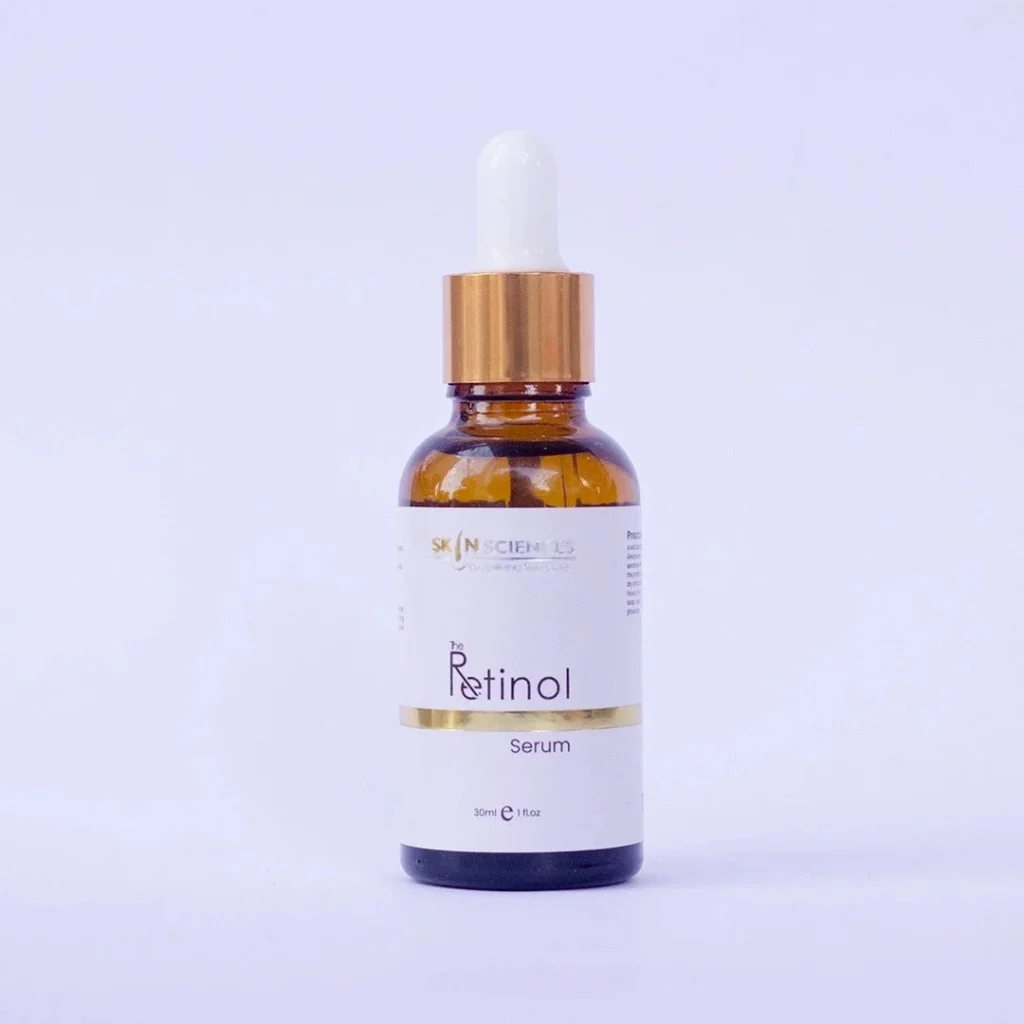
Yes, many people can eventually use retinol serum every day, but daily use is usually something you build toward rather than start with. For beginners, dermatologists commonly recommend using retinol every other night first, then gradually increasing frequency if the skin remains comfortable. Skinsciences’ encapsulated retinol approach is designed with tolerance in mind.
Key Takeaways
- Don’t start retinol serum every night immediately if you are new to retinoids.
- Begin with 2–3 nights per week or an every-other-night schedule.
- Increase frequency only when your skin is tolerating the product without persistent burning, redness, excessive peeling, or dryness.
- Apply retinol at night and use broad-spectrum SPF every morning.
- Moisturizers containing ingredients such as ceramides, niacinamide, or hyaluronic acid can help support the skin barrier.
- Visible improvements take time. Clinical studies of retinol formulations have documented meaningful changes over approximately 8–12 weeks, with benefits continuing with longer use.
Can You Use Retinol Serum Every Day?
Yes, daily retinol can be appropriate for some people once their skin has developed tolerance. However, how often you should use retinol serum depends on the retinol concentration, formulation, your skin type, previous retinoid experience, and how your skin responds.
Retinol is a form of vitamin A and belongs to the broader retinoid family. It is converted within the skin through several steps toward retinoic acid, the biologically active form responsible for many retinoid effects.
The American Academy of Dermatology notes that retinoids can help with concerns such as mild acne, pigmentation irregularities, fine lines and wrinkles, while also emphasizing gradual introduction to reduce irritation.
So if you’re asking, “Can I use retinol serum every day?”, the practical answer is:
You can work toward daily use if your skin tolerates it but you don’t need to use it every night to get benefits.
Consistency matters more than rushing.
Why You Can’t Start Using Retinol Every Night Immediately
Retinol works by influencing processes including skin cell turnover and pathways associated with collagen production. That activity is one reason retinol is valued in anti-aging skincare, but it is also why a new user may experience temporary dryness or irritation.
The skin needs time to adapt.
The Adjustment Period Explained
When you first introduce retinol, your skin may react differently from someone who has already used retinoids for months.
A gradual schedule gives your skin an opportunity to adjust while you monitor:
- Dryness
- Tightness
- Peeling
- Redness
- Stinging
- Burning
- Increased sensitivity
The AAD specifically recommends starting with a less-intense retinoid and using it every other night before gradually building frequency.
This is particularly important for people with sensitive, dry, dehydrated, or easily irritated skin.
What Happens If You Rush Retinol
Using too much retinol too frequently can overwhelm the skin barrier.
Common retinol serum side effects can include:
- Dry or flaky skin
- Redness
- Burning or stinging
- Increased sensitivity
- Irritation around the nose and mouth
- Tight or uncomfortable skin
More retinol does not necessarily mean faster results.
In fact, severe irritation can make it difficult to maintain a consistent routine.
For people with darker skin tones, irritation deserves particular attention because inflammation can sometimes contribute to post-inflammatory hyperpigmentation. The AAD recommends starting slowly and using moisturizer to reduce this risk.
The Dermatologist-Recommended Retinol Schedule (Week-by-Week)
A practical beginner schedule is to start slowly and increase frequency only when your skin is comfortable. Dermatologist Joshua Zeichner has described a protocol of every other day for the first two weeks, followed by two nights on and one night off for two weeks, and then nightly application if there is no irritation.
Weeks 1–2: 2 Nights Per Week
If you’re completely new to retinol, starting with two nights per week is a conservative approach.
For example:
| Day | Retinol |
| Monday | ✓ |
| Tuesday | — |
| Wednesday | — |
| Thursday | ✓ |
| Friday | — |
| Saturday | — |
| Sunday | — |
If your skin is particularly sensitive, you can leave even more recovery time between applications.
Use a small, pea-sized amount for the entire face, rather than applying a large amount to individual areas.
Weeks 3–4: Every Other Night
If your skin has remained comfortable, move toward retinol every other night.
A schedule might look like:
Monday → Wednesday → Friday → Sunday
Then continue alternating.
At this point, monitor your skin rather than following the calendar blindly.
If you develop persistent redness, burning, significant peeling, or discomfort, reduce frequency again.
Week 5 Onwards: Building Toward Nightly Use
After several weeks of tolerance building, some people may be able to use retinol serum every night.
Dr. Zeichner’s cited protocol allows progression to nightly application after approximately one month when there is no irritation.
However, nightly use is not a requirement.
If your skin looks and feels healthy using retinol three or four nights per week, there is no need to force daily application simply because the product is capable of being used more frequently.
Retinol Ramp-Up Schedule
| Stage | Frequency | Main Goal |
| Weeks 1–2 | 2 nights/week | Introduce retinol gently |
| Weeks 3–4 | Every other night | Build tolerance |
| Week 5+ | Gradually toward nightly | Maintain only if comfortable |
| Any stage | Reduce frequency if irritated | Protect the skin barrier |
This schedule is a starting framework, not a medical prescription. A dermatologist may recommend a different frequency depending on your skin and the retinoid being used.
How Skinsciences Formulated Its Retinol Serum for Daily Tolerance
Skinsciences Retinol Serum uses 0.5% encapsulated retinol according to the brand’s published product information. The brand describes its encapsulation/time-release approach as a way of gradually delivering retinol to the skin rather than relying on a conventional non-encapsulated delivery system. (Skin Sciences)
Why does that matter?
Retinol is sensitive to environmental conditions, and delivery technology can influence how an active ingredient reaches the skin.
Research into encapsulated retinol has found that encapsulation can protect retinol from degradation and provide controlled release; one study also reported lower irritation with a controlled-release formulation compared with its comparator formulation.
Clinical research has also evaluated encapsulated 0.5% retinol in a 12-week facial regimen and reported improvements in several measures of photodamaged skin, with dryness being the main tolerability finding that increased significantly.
Why 0.5% Encapsulated Retinol Is Different From “Just Retinol”
The number printed on a retinol product is only one part of the formulation story.
Two products containing the same nominal retinol concentration can behave differently depending on:
- Delivery system
- Stabilization
- Supporting ingredients
- Vehicle
- Packaging
- Application frequency
- Individual skin tolerance
That is why how to start retinol serum matters just as much as which serum you choose.
Important transparency note: the currently available public Skinsciences information verifies the 0.5% encapsulated-retinol claim, but does not provide enough independently verifiable information to confirm a specific airless/opaque packaging specification. That packaging detail should be added to the published article only after the brand confirms it internally.
Signs You’re Ready for Daily Retinol Use (And Signs You’re Not)
Your skin usually tells you whether it is ready for more frequent retinol.
Signs You May Be Ready
You may be ready to increase frequency if:
- Your skin is comfortable between applications.
- You have little or no persistent redness.
- You aren’t experiencing burning or stinging.
- Peeling is minimal or absent.
- Your normal moisturizer no longer feels uncomfortable.
- You have maintained your current frequency consistently for several weeks.
Signs You’re Not Ready
Stay at your current frequency or reduce it if you notice:
- Persistent burning
- Significant redness
- Cracking
- Severe dryness
- Painful sensitivity
- Excessive peeling
- Swelling
- Irritation around the eyes or mouth
The goal isn’t to “push through” irritation.
The goal is to find the highest frequency your skin can comfortably maintain.
How to Use Retinol Serum Correctly for Best Results
Knowing how often I should use retinol serum is only half the equation. Application technique also matters.
1. Cleanse Gently
Start with a gentle cleanser.
Avoid aggressive scrubbing immediately before applying retinol.
Pat your skin dry and allow it to settle before applying your serum.
2. Apply a Small Amount
For the full face, a pea-sized amount is generally sufficient.
More products do not automatically produce faster results.
Apply small dots across the forehead, cheeks and chin, then spread evenly while avoiding the immediate eye area and corners of the nose and mouth if these areas are prone to irritation.
The Moisture Sandwich Method
The moisture sandwich method is a useful strategy for people who find retinol drying.
A simple version is:
- Apply a thin layer of moisturizer.
- Allow it to settle.
- Apply a small amount of retinol.
- Follow with another layer of moisturizer.
This can make the routine more comfortable for beginners.
Some people prefer applying retinol directly to clean, completely dry skin and moisturizing afterward. Others find sandwiching more tolerable.
There isn’t one universally correct method the appropriate approach depends on your skin and formulation.
What to Pair With Retinol and What to Avoid
Retinol doesn’t need an elaborate routine.
Good supporting ingredients can include:
- Ceramides — barrier-supporting lipids
- Hyaluronic acid — helps support skin hydration
- Niacinamide — can support the skin barrier and overall skin comfort
- A simple moisturizer
- Broad-spectrum sunscreen
Be more cautious about using multiple potentially irritating activities on the same night.
Depending on your skin, combining retinol with strong exfoliating acids, scrubs or other irritating acne treatments can increase discomfort. Dermatologists commonly recommend keeping the routine simple when beginning a retinoid.
A simple retinol serum routine could be:
PM:
Cleanser → moisturizer → retinol → moisturizer
AM:
Gentle cleanser → hydrating/antioxidant products → moisturizer → broad-spectrum SPF
SPF Is Non-Negotiable
Retinol belongs in your nighttime routine, but sun protection belongs in your morning routine.
The AAD recommends nighttime use and daily sun protection because retinoids can increase sensitivity to sunlight, while retinol itself is also susceptible to degradation from light. Use a broad-spectrum sunscreen every morning and reapply as appropriate for your exposure.
If you’re investing time in a retinol serum for anti aging, daily sun protection is essential to your overall skincare strategy.
Retinol Purge vs. Irritation: They’re Not the Same
One of the biggest misconceptions about retinol is that every breakout or peeling episode is a “purge.”
It isn’t.
What Is a Retinol Purge?
A purge can occur when a retinoid accelerates skin cell turnover and brings existing microcomedones toward the surface more quickly.
When it happens, breakouts tend to occur in areas where you normally experience acne.
What Does Irritation Look Like?
Irritation is more likely when you experience:
- Burning
- Persistent redness
- Significant dryness
- Stinging
- Raw or uncomfortable skin
- Widespread peeling
If the skin is burning or becoming increasingly inflamed, simply calling it a “purge” and continuing at the same frequency is not a good strategy.
Reduce frequency and simplify your routine. Persistent or severe symptoms should be discussed with a dermatologist.
How Long Does Retinol Take to Work?
Retinol is a long-game ingredient.
You may notice changes in skin softness or texture earlier, but significant visible improvement generally requires consistent use over several weeks.
Clinical studies have documented measurable improvements around 8 weeks, while other controlled research has evaluated meaningful outcomes at 12 weeks and beyond)
For example, a 2024 pooled analysis of six vehicle-controlled studies involving 0.1% stabilized bioactive retinol found improvements in signs of photodamage beginning as early as week four and continuing through week 12. Reported irritation was generally mild and transient.
Another controlled study of stabilized 0.1% retinol found improvements in lines, wrinkles, pigmentation, elasticity, firmness and overall photodamage after eight weeks.
So if you’re wondering how long retinol takes to work, think in terms of weeks to months—not days.
Real Results: What Skinsciences Users Experienced
Real-world experience is valuable, but skincare claims should not be presented as clinical evidence unless they are supported by a properly designed study.
Skinsciences describes its retinol formula as using 0.5% encapsulated retinol and positions the formulation around gradual delivery and improved tolerance.
For an E-E-A-T-focused product page or article, the strongest approach is to publish verified customer experiences separately from controlled clinical evidence.
Useful experience signals can include:
- How many weeks users applied the product
- How frequently they used it
- Their skin type
- Whether they were new to retinol
- Changes in texture
- Changes in the appearance of fine lines
- Whether dryness or peeling occurred
- Whether they needed to reduce frequency
Avoid turning individual testimonials into promises such as “this serum will remove wrinkles” or “this product cures acne.”
Individual experiences vary.
How We Tested: A Transparent Tolerance-Testing Framework
A publishable testing methodology can evaluate a retinol serum over 8–12 weeks, recording:
- Skin type: oily, dry, combination and sensitive
- Previous retinoid experience
- Initial frequency of application
- Frequency progression
- Dryness and peeling
- Redness and stinging
- Texture changes
- Appearance of fine lines
- Overall tolerance
- User-reported comfort
The testing protocol should photograph or assess participants under consistent conditions and document adverse reactions rather than selecting only positive outcomes.
This distinction matters: consumer-use testing, laboratory testing and controlled clinical trials are not interchangeable forms of evidence.
Published research supports the use of 8–12-week evaluation periods for retinol outcomes. For example, controlled studies have reported improvements at 8 and 12 weeks, while longer studies demonstrate that benefits may continue with ongoing use.
Retinol Is One of the Most Studied Ingredients in Anti-Aging Skincare
Retinol is not a new skincare trend.
Retinoids have decades of dermatological research behind them, and retinol has been studied for visible signs of photoaging including fine lines, pigmentation and skin texture.
A randomized, vehicle-controlled study published in Archives of Dermatology found that topical 0.4% retinol improved fine wrinkling after 24 weeks and was associated with increased markers of procollagen and glycosaminoglycan expression.
Another controlled one-year study of stabilized 0.1% retinol found significant improvements in photodamage, including crow’s feet and mottled pigmentation, with evidence of increased type I procollagen expression.
This is why retinol remains an important ingredient for people interested in retinol for beginners, texture, uneven tone and visible signs of skin aging.
But “well studied” does not mean “risk-free.”
Tolerance still matters.
Who Should Be More Careful With Retinol?
Retinol isn’t appropriate for everyone.
People with significant dryness, active irritation, inflammatory skin conditions or a compromised skin barrier may need professional guidance before introducing a retinoid.
The AAD notes that people with substantial redness or inflammation may not be good candidates for retinoids without appropriate assessment
Pregnancy and Breastfeeding Warning
Do not start or continue retinol during pregnancy without medical advice.
The American Academy of Dermatology advises avoiding retinoids, including over-the-counter skincare containing retinol, during pregnancy. ACOG likewise recommends avoiding topical retinoids during pregnancy.
If you are pregnant, trying to conceive, or breastfeeding, discuss your skincare routine with your obstetrician, dermatologist or other qualified healthcare professional before using a retinoid product.
This article is educational and does not replace individualized medical advice.
Frequently Asked Questions
Can I use retinol serum every day?
You may eventually be able to use retinol serum every day if your skin develops adequate tolerance. However, beginners should usually start less frequently and increase gradually. If irritation develops, reduce frequency rather than forcing nightly use.
How often should I use retinol serum as a beginner?
A practical starting point is two nights per week, followed by every-other-night use if your skin remains comfortable. Some dermatologists recommend beginning every other night and progressing after several weeks.
Can I use retinol serum every night?
Yes, some experienced users can tolerate a retinol serum every night. But nightly use is not mandatory. Your ideal frequency is the highest frequency your skin can comfortably maintain.
What is the best retinol serum for sensitive skin?
There is no single best retinol serum for every sensitive-skin user. Look for a well-formulated product with a concentration appropriate for your experience and consider delivery systems such as encapsulated retinol. Most importantly, introduce it slowly and support the skin barrier with moisturizer. Research suggests encapsulation can influence retinol stability and release.
Can I use retinol with niacinamide?
For many people, niacinamide can fit comfortably into a retinol routine and may complement a barrier-supportive skincare approach. If your skin is highly sensitive, introduce products one at a time so you can identify what causes irritation.
How long does retinol take to work?
Some users notice texture or softness changes sooner, but significant visible improvements generally take several weeks. Research has demonstrated measurable improvements around 8–12 weeks, with longer-term use continuing to produce benefits.
Should I stop retinol if my skin is peeling?
Mild adjustment can occur, but significant peeling, burning, persistent redness or discomfort suggests that your routine may be too aggressive. Reduce frequency, focus on gentle cleansing and moisturization, and seek professional advice if symptoms are severe or persistent.
Final Verdict: Is Daily Retinol Right for Your Skin?
So, can I use retinol serum every day? Eventually, you may be able to but you don’t need to rush there.
For a beginner, starting with two nights per week and gradually progressing toward every other night and then potentially nightly use is a sensible tolerance-building strategy. Dermatologists including Joshua Zeichner have recommended a gradual schedule, with nightly use considered only after the skin has demonstrated good tolerance.The most important principle is simple:
Retinol works best as a consistent routine, not an overnight challenge.
Start slowly. Use a small amount. Moisturize. Keep irritating activities under control. Apply retinol at night. Wear SPF every morning. And give the ingredient enough time to work.
Skinsciences’ 0.5% encapsulated retinol provides a formulation designed around controlled delivery, while published research supports the broader efficacy of retinol for visible signs of photoaging. (Skin Sciences)
If your skin is comfortable with retinol every other night, there is no need to force daily application. The best retinol serum routine is the one your skin can tolerate consistently over the long term.